

Javier Burón: Public realism that challenges the real estate trench
The former Housing Manager of Barcelona and current director of Nasubinsa analyses the key role of estate agents in the current crisis and proposes changing the rules of the game.
To understand the magnitude of the housing labyrinth in our country, it is essential to sit down and listen to those who have managed public complexity from positions of maximum responsibility. Javier Burón belongs to that rare breed of technicians with a peripheral vision and an institutional mileage that is hard to match: he was Deputy Minister of Housing for the Basque Government, Manager of Housing for the Barcelona City Council between 2015 and 2023, and currently leads Nasubinsa, the public housing and territorial cohesion company of the Government of Navarre. He recently published the book «La crisis de la vivienda» (Arpa, 2025).
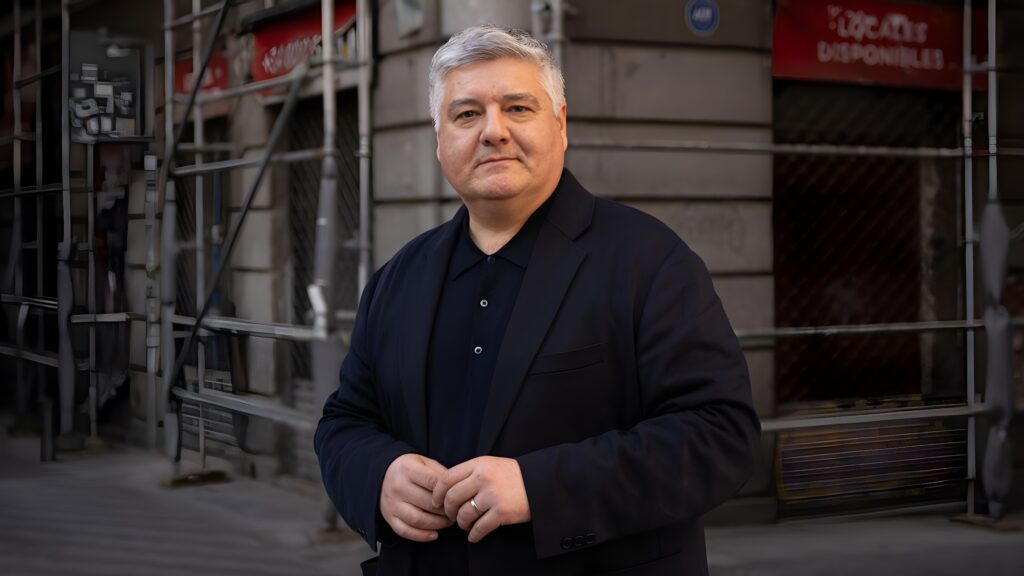
This article is the direct result of a dense, self-critical and highly enlightening conversation held with him in the podcast Real People on the current housing crisis. In a landscape where the housing debate is often reduced to an ideological trench, Burón’s perspective offers us an exercise in pure realism: analysing the impact of intermediation, the urgency of regulating sector minimums and, above all, the ethical and generational conflict in which estate agents find themselves trapped on a daily basis.
Instrumental co-responsibility: neither saints nor demons
The starting point of the analysis of Javier Burón it eschews the simplistic demonisation sometimes directed at agencies. By comparing his view with currents of opinion that accuse portals and agents of directly causing price rises, Burón introduces a sensible and professional nuance of shared responsibility:
«Whatever is happening in the housing market, for better or worse... agents bear some responsibility because you are the professionals who speak with landlords, potential clients and hold an instrumental position that is key.
For Burón, The estate agent acts as a mirror of the type of market, society, and autonomous community in which they operate. There is no single picture of the sector because Spain is diverse, but as it is the final link that «seals the deal» in transactions accounting for around 10% of GDP and 13% of national employment, its role is no longer peripheral but has become central. If public agencies accept their share of responsibility for the current state of the market, the private brokerage sector must do exactly the same.
The regulatory labyrinth and the autonomist paradox
One of the most controversial topics of the talk was the lack of homogeneous regulation of the profession in Spain. Whilst sectors such as healthcare, law and architecture show complete uniformity when it comes to demanding regulatory frameworks and strong professional bodies, the real estate sector coexists with enormous fragmentation.
Burón reveals that state inaction is partly due to the fear of encroaching on areas of jurisdiction and the coexistence of multiple professional associations and agents operating independently. However, his experience in the Government of Navarre demonstrates that when there is technical will and the sector pushes together, mutual understanding is immediate. Accepting that contracts involving intermediaries are no minor matter, Burón advocates the mandatory implementation of non-negotiable minimums:
- Traceability and insurance: A strict requirement for civil liability and cover that protects the final consumer.
- Continuing professional development: Mandatory technical training for operating in increasingly sophisticated and tense markets.
- Separate the wheat from the chaff: Burón complains that, in the highest-pressure environments, there are officers who demand legal certainty while openly stating that they are not going to apply clear and unambiguous legal provisions. In such scenarios, if the sector fails to self-regulate, regulatory intervention becomes inevitable.
Faced with the idea of creating «public estate agents» — a proposal he describes as a whim that does not enthuse him due to the surplus installed capacity in the private sector —, he advocates squeezing public-private collaboration formulas before resorting to extreme derivatives. He exemplifies this with municipal agreements that allowed private agents to act as approved mobilisers for affordable rental pools; tools which, due to a lack of communication or mutual disinterest, often end up dead in the water and which it is urgent to rescue.
The generational conflict: Managing assets or economic activities
The high point of the conversation comes when addressing the daily dilemma of the contemporary estate agent. In their routine, the professional signs a service contract with the landlord (usually belonging to an older generation, with established wealth) and is bound to defend their interests, which generally involve squeezing profitability to the maximum. At the same time, it is this very agent who faces the music and acts as a «one-stop shop for complaints» to a young generation of tenants facing serious difficulties in accessing housing. How is this ethical conflict resolved?
For Javier Burón, the main misdirection lies in the mentality of the atomised landlord. Many private individuals who own one or two homes do not accept that by putting them up for rent they are developing an economic activity with a profound social impact, misinterpreting it as mere passive asset management.

The current market, especially in high-pressure areas, has become a jungle because clients have not been educated about the existence of different playing fields. Burón argues that agents have a duty — and a need — to start categorising and naming property owners' attitudes:
- The high-risk model: That landlord who chases the last penny of rent, demands constant rotation and rejects responsible tenant screening. The agent must be educational and explicitly warn: the greater the aggressiveness and profit, the greater the risk of suffering contractual problems, financial slaps and fiscal or legal disincentives.
- The quiet and conservative model: He or she who decides to set the price prudently (for example, a percentage below the market average) in exchange for stability, legal security and a process of human discernment to choose their tenant. Reducing risk and flattening the price does not mean not making money; it means gaining peace of mind and committing to long-term relationships.
The master key: dynamiting the distance between two worlds
When asked for a master key for real estate agents to become agents of positive change, Javier Burón rules out providential advice and opts for maturity and mutual recognition. His verdict is crystal clear: The public sector and the private sector have been operating for too long as two watertight worlds that do not speak to each other, feeding mutual prejudices.
Real transformation requires that general directorates for housing stop navel-gazing and identifying exclusively with social housing or contractual limitations, and instead start designing joint services for training, consumer information and support in complex processes such as buying and selling.
For the market to regain equilibrium, professionals from both houses must start getting to know each other, exchanging technical knowledge that only the other party possesses, and collaborating in a transparent manner. Only by narrowing that institutional distance will we be able to pacify the most hostile environments and build, together, a much healthier, more predictable and more humane housing market.