

Magda Teruel: AI doesn't replace the estate agent, it replaces their tasks
The computer engineer and tech communicator debunks the sector's fears regarding artificial intelligence and explains how to turn it into the ultimate copilot without losing the human warmth of the profession.
There are profiles that are valuable precisely because they build bridges between worlds that rarely intersect. Magda Teruel she is one of them: computer engineer by training, with almost twenty years dedicated to making technology work for people and not the other way around. Lecturer at ISDI and La Salle, communicator at magda.es and passionate about how tools like Copilot can enhance — never replace — our skills.

Magda Teruel sat down in the third edition of the podcast Real People to discuss a topic that concerns the real estate sector with a mixture of fascination and vertigo: is artificial intelligence going to replace the estate agent?
Her response, far from alarmism and blind enthusiasm, proposes an exercise in common sense: understanding which parts of the trade artificial intelligence is going to transform and which ones are going to remain, much to the dismay of some, hopelessly human.
Neither substitution nor paralysis: task transformation
Faced with the million-dollar question — is the estate agent going to disappear? — Teruel is clear: AI has entered the sector «like a bull in a china shop», but its effect will not be to replace people, but rather the more mechanical tasks that are currently done manually, archaically and often chaotically. What will remain untouched, she stresses, is everything to do with negotiation, with reading a situation, a client or a market, and with managing expectations and conflicts. That part of the job — the one that is sometimes the hardest — will continue to rest in human hands.
The key is not just about doing things faster, but doing them with higher qualityfreeing up time from tedious tasks and devoting it to what truly adds value, from negotiating to simply being able to take the kids to the park on a Saturday morning instead of doing expenses.
Machine efficiency, human warmth
Buying or selling a home is a long, emotional and complex process: the antithesis of the one-click experience. For Teruel, therein lies precisely the balance sought by well-applied technology: reducing friction in the parts of the process that can be automated —comparisons, notifications, error management— without touching the ground where the estate agent remains irreplaceable. Technology, in short, has to be a lever, not a substitute for human understanding.
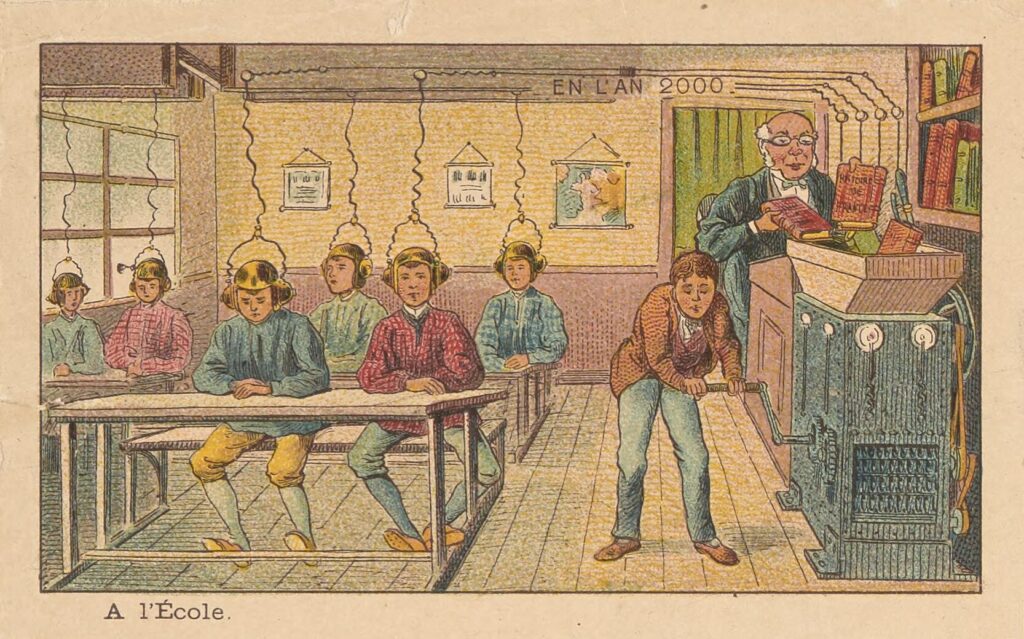
«In the Year 2000 (c. 1900)
The fear of the two-speed approach
One of the most widespread fears in small agencies is being left behind by big brands with the budget to develop bespoke AI. Teruel qualifies that fear: he believes Artificial intelligence is, today, one of the most democratised technologies that exist. A well-trained self-employed professional with the right tools can compete with standard software, templates, pre-configured agents and prompt libraries that anyone can activate without major investment. The challenge is not financial, but one of learning: just as people once had to learn how to use Outlook, now it is time to learn how to use these new tools, asking for help if necessary.
Experience as an advantage: advice for beginners
For the estate agent who feels overwhelmed —and Teruel is thinking particularly of senior profiles in a sector that is not exactly young—, his message is one of empowerment: experience is an advantage, not an obstacle. Knowing what to ask and knowing how to validate the AI's response is something that only experience brings; a junior profile wouldn't even know where to start.
Very practical tips:
Ask as you go along. Use the built-in Copilot button in the Edge browser while browsing a property portal or a PDF, to ask how a property compares to the competition or how to handle a client's objections.
Check before sending. Ask the AI to summarise the three main points of a document before sending it, as a quality control measure: if it matches what you wanted to communicate, the text is well constructed; if not, it needs revising.
Stop taking notes. Record client meetings in Teams so that AI can transcribe them and later generate a client profile detailing their needs, freeing the agent up to focus on making eye contact and listening.
Automate descriptions. Take advantage of the new Copilot feature in Excel, a formula that automatically generates property descriptions from table data — rooms, orientation, neighbourhood, condition — and updates them if that data changes.
«AI is like an intern. You have to explain things to it in detail, give it references, ask for a specific style and a specific number of pages... and, above all, always review what it hands in.»
The biases that cannot be seen
Teruel also focuses on a less discussed aspect: biases. AI is trained on human content, and human content carries conscious and unconscious biases. Remember how early versions of GPT even suggested automatic cars to women «because they probably find driving difficult». That extreme case has been corrected, but it warns that subtler biases — those that are not so obvious — are still there and it is worth keeping them in mind, especially in a sector where AI will begin to mediate in purchasing decisions.

«In the Year 2000 (c. 1900)
The new SEO and digital presence
The conversation also touches on a fundamental shift: the gradual demise of traditional SEO. More and more search engines are displaying an AI-generated answer directly, rather than a list of links, which has already led to a significant drop in traffic to some websites. For Teruel, this forces brands – including agencies – to consider a new type of positioning, designed so that language models «read» and prioritise their content. And he urges us not to take anything for granted about where the audience is: if buyers ten years from now are on TikTok, that is where the sector will have to be too.
The master key: treating AI like an intern
When asked for a single piece of advice for those who view artificial intelligence as a threat rather than an ally, Magda Teruel sums it up with a very vivid image: AI is like an intern. You have to explain things to him in detail, give him references, ask for a specific style and a specific number of pages... and, above all, always check what he submits.
Her final recommendation is to lose the fear, try it out on tasks where you can judge for yourself whether the result is good or not, and ask yourself, before each routine task, whether AI could help to do it better or differently. It is not always about going faster: sometimes, it is about doing it better.