
Reconnecting city and nature: Interview with ‘cómo crear historias’
In this interview they share with us in detail their creative process and their concept of «regenerative design».
If you put an architect, a psychologist, a landscape designer, a biologist and a designer into a shaker, the result wouldn't be a joke, but quite the opposite. The tandem formed by Monica y Javier, the minds at the forefront of ‘how to create stories’, uniquely combining the urban and the rural, creates narratives that always put people and their needs at the centre, resulting in inclusive and sustainable architectural projects that manage to make the absolute most of their environments.
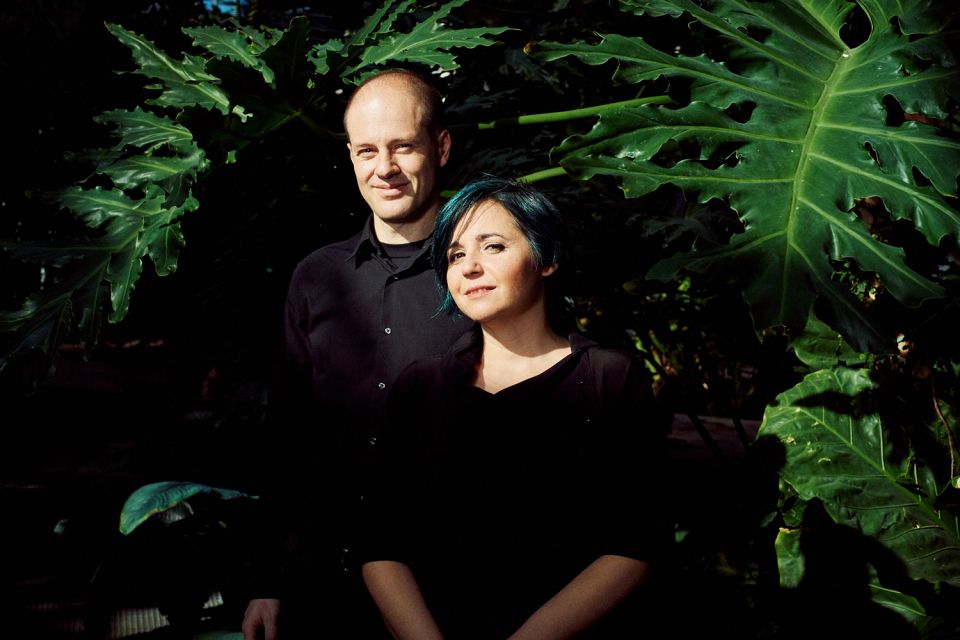
Photo: © Craus Fotografías
Tell us about yourselves and your work. Where did your vocation begin? Any first memories?
Our architecture and landscape practice, ‘cómo crear historias’ (@comocrearhistorias (on Instagram), it was born 19 years ago. We are called that because our projects generate experiences and are themselves told as stories where the protagonists of the spaces are people along with other living beings and their environment. We are conditioned by the city and the environment in which we live because it largely determines our relationships, our wellbeing and our creativity.
Right from the start, we realised that what we are most passionate about, alongside architecture and storytelling, is landscape; natural processes; the integration of nature into the built environment and vice versa; its connection with people and other living things; the wellbeing they generate and their ability to stimulate creativity. What we do is create places that integrate nature-based solutions, naturalising spaces with people and other living things in mind through biophilia. In short, we do regenerative design.
Our interest in these issues arises from four needs: creativity; contact with nature; care and mutual support among living beings, as well as the mitigation of and adaptation to climate change; and the incorporation of the circular economy into projects.
What do you find most satisfying about your work, and is there anything you are particularly proud of?
The act of creation itself is very satisfying, as is being able to link it to the landscape, the people and other living beings that inhabit spaces, whether indoors or outdoors. From the early moments when everything is possible, through the research process that precedes every project, the exciting initial ideas, the final delivery and seeing how it grows when inhabited.
Every project has a piece of us. Some have been more intense than others. The one that has left a big mark on us is “The mysterious story of the garden that produces water".
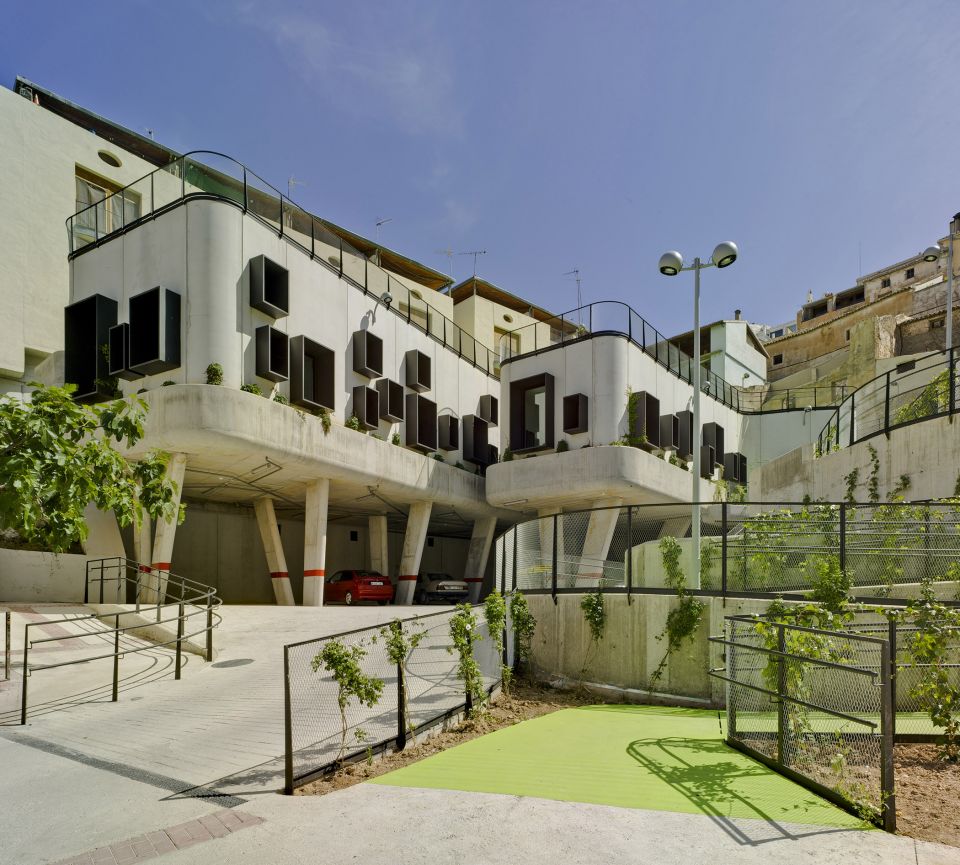
Photo: © David Frutos
This place was a great void, a wound at the back of the upper area of Cehegín. Through an urban renaturalisation process, we alleviated a major disconnection in the old town. We created a public space from which a vertical and horizontal garden springs, where flora attracts fauna, bringing biodiversity to the surroundings. With the help of riparian plants, we purify the dirty water generated in the upper part of the municipality. We thus obtain water suitable for irrigating the garden.
We are giving back the natural paths to walkers, the desire paths, making it possible to enjoy a sea of Murcian rooftops and market gardens. We even hide, in a pocket of the promenade, a building that houses a business incubator, a coworking space with shared offices where initiatives emerge whose creativity is stimulated by this fantastic created environment.
Creating this space, seeing it work and having the people who enjoy it appreciate it and even thank you for it makes all the years of invested work worthwhile.
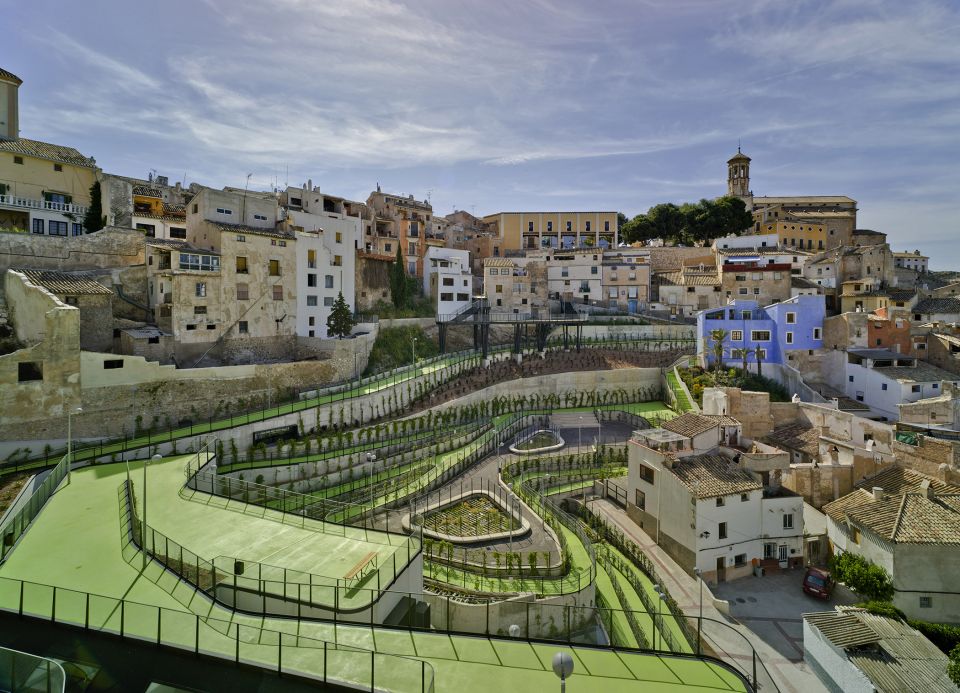
Photo: © David Frutos
What is your creative process like, what are your sources of inspiration?
Our inspiration is precisely those wounds of the place that we locate through cross-sectional research, from various approaches: environmental psychology, the environment, biology...
We seek this inspiration from a dual approach: on a human scale, through observation, the investigation of the traces of the place, its ecosystem, the cultural landscape and the participation of the people who inhabit the spaces to carry out a kind of ethnographic analysis linked to the environment that serves as the basis for the design. Intertwined with the challenge of the human scale, we incorporate a series of renaturalisation strategies through nature-based solutions.
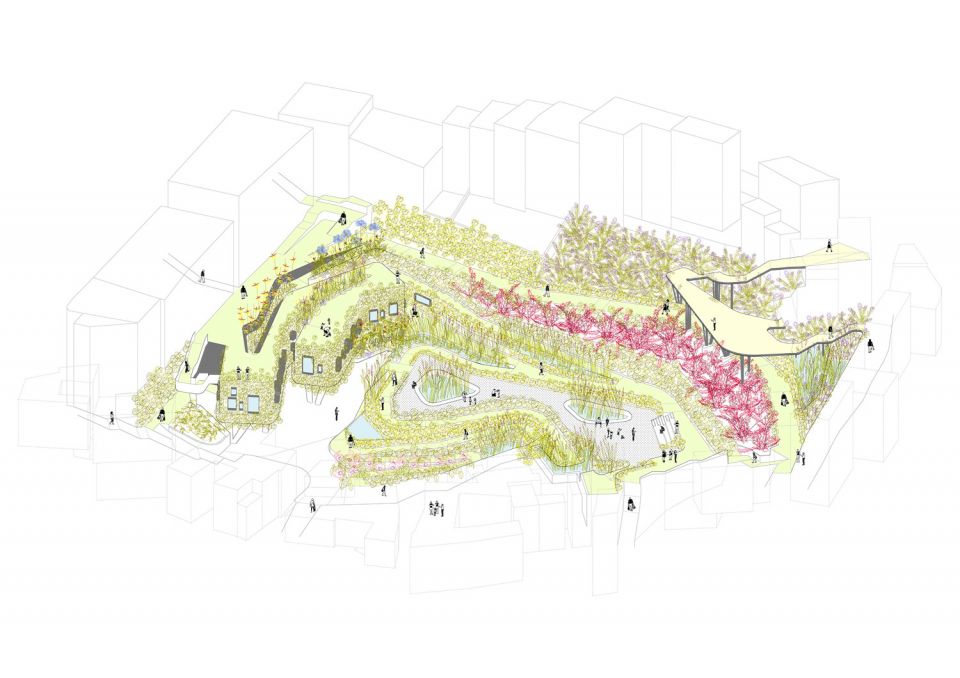
Based on the research process, we developed a narrative whose title in itself is a complete micro-story. The story emerges and weaves the project together through interaction with the environment and the people. It is an iterative, artisanal process of continuous back and forth. The narrative feeds the project and vice versa. We move from freehand sketching, which allows us to discover a story in the act of drawing, to then moving to the computer and processing the drawing using CAD. The new drawing is printed, translucent paper is placed over it, and it is drawn on by hand once again. That drawing is put back into CAD, and so on until we get to know the narrative well enough to be able to tell it. Freehand drawing makes the researched data resonate in our heads and gradually reveals the story that the place needs.
© How to create stories
Favourite colour, book, film and record - in that order! ;D
Turquoise.
Life: A User's Manual, by George Perec.
In the Mood for Love, by Wong Kar Wai.
Music for Airports, by Brian Eno.
Is your home a reflection of who you are? Tell us what it smells like, your favourite corner, decorative object or must-have piece of furniture, whether you treasure any collection...
Our home is closely linked to our way of life and who we are. Everything is connected and fits together like a jigsaw. It is a place where the domestic and the creative process go hand in hand. We collect music, plants and books that serve as inspiration during the creative process. Together they enrich the space and transform it into an oasis.
If you could buy anything right now and take it home, what would it be? Anything!
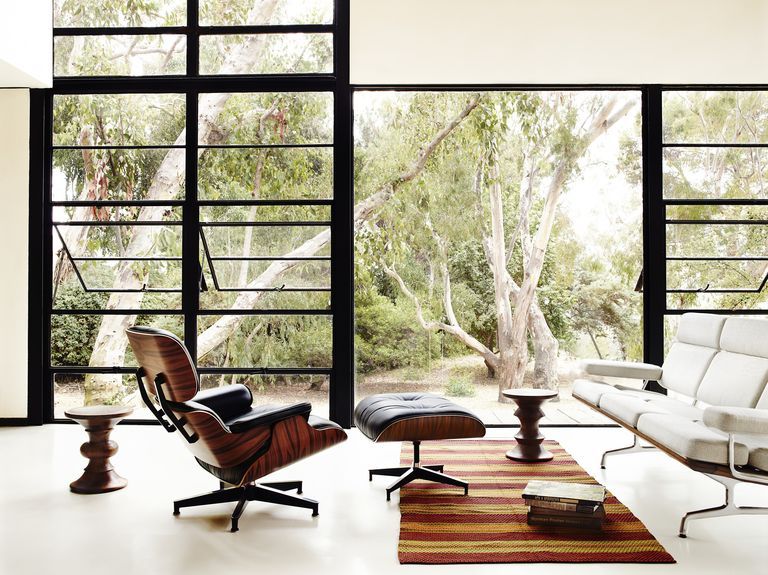
The Charles & Ray Eames Lounge Chair.
A great plan at home always includes...
A good series and binge-watching.
Do you have any star dishes?
Sushi!
Where is your favourite place in your city and abroad?
We live in Rivas and our favourite place here is a walk through the Southeast Regional Park. Abroad, the Estufa Fría in Lisbon and the Hoge Veluwe National Park in the Netherlands.
Anything you want to tell us that we haven't asked you - speak now or forever hold your peace!
For us, every project is unique. We work with a network of professionals from different disciplines to create a team that suits each project, or we can become part of an existing team. We are always looking for people who need our creativity to improve their environment through the integration of nature into architecture. If you are one of them, you already know where to find us.